

The convergence of creative legacy and artificial intelligence: Disney's dual strategy marks a turning point for the industry.
This image is AI-composed, using Manus.IM.
In a move that is sending shockwaves through both Hollywood and Silicon Valley, The Walt Disney Company has executed a stunning dual-pronged move that is set to redefine the relationship between artificial intelligence and intellectual property. By simultaneously investing a billion dollars in OpenAI and licensing its beloved characters for use in the Sora video generation app, while also serving a cease and desist letter to Google for alleged copyright infringement in its AI training models, the House of Mouse has drawn a clear line in the sand. This is not just a business decision; it’s one of the powerhouses of traditional media indicating that the era of AI companies training their models on copyrighted content without permission is over. The future of AI is one where licensing is part of the fundamental cost of doing business and the time for the deals is NOW.
The Disney Strategy: A Tale of Two AIs
Disney’s dual strategy implies some thoughtful strategic positioning. On one hand, the company is embracing the potential of generative AI by partnering with OpenAI. The three-year agreement allows users of OpenAI’s Sora and ChatGPT Images to create content featuring over 200 characters from the Disney, Marvel, Pixar, and Star Wars universes. From Mickey Mouse and Cinderella to Iron Man and Darth Vader, fans will be able to generate short-form videos and images that incorporate these beloved characters into their own creative expressions.
This move not only opens up new avenues for fan engagement but also may arm Disney with a firehose of user-generated content that can be curated and featured on its Disney+ streaming service. This content provides them a possible alternative to TikTok and YouTube Shorts that are preferred by many modern consumers. The deal includes a billion-dollar investment in OpenAI, with options to invest more, and an embrace of their products for Disney employee use, too. When I first read about the investment, I was worried that this might be another calamitous technology decision like paying so much money for Infoseek way back in 1999 (full disclosure: I worked in Disney’s technology division as a producer from 1995-2002).
But as the pixie dust settled on the details, I saw how this deal comes with a critical caveat that cannot be overstated: OpenAI is explicitly prohibited from using Disney’s intellectual property to train its foundational models. This distinction between licensing for output versus licensing for training is the cornerstone of Disney’s strategy. Users can prompt Sora to include Disney characters in their generated videos, but OpenAI cannot consume Disney’s vast library of films, shows, and other content to improve its underlying AI models. This is licensing for creative expression, not licensing for model development. It’s akin to Disney’s deal to use characters in Fortnite or allowing memes to flourish on social media, not enabling OpenAI to extract the precious value of Disney’s top-notch IP to enable copycat content from generative models.
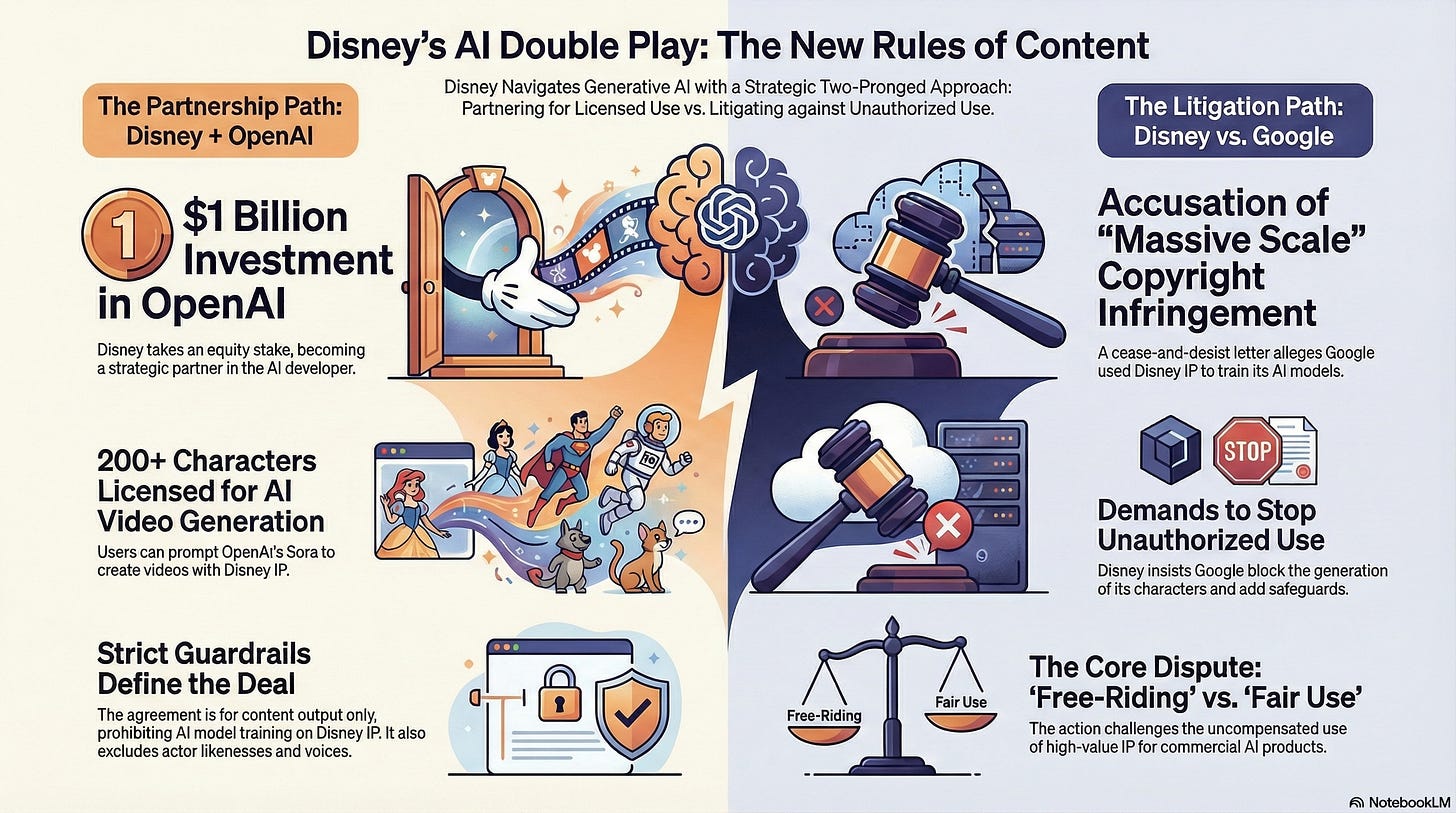
This infographic was created in NotebookLM from my research and commentary.
On the other hand, Disney is taking a hardline stance against what it perceives as the unauthorized use of its content. The cease and desist letter to Google alleges that the tech giant’s AI services (including its Veo, Imagen, and Nano Banana models) have infringed on Disney’s copyrights on a “massive scale”. The letter accuses Google of leveraging its dominance to flood the market with infringing works, of treating Disney’s valuable characters as its own by making them available to subscribers for a fee, and of refusing to implement technological measures to prevent copyright infringement even though such measures are readily available and being used by Google’s competitors. How Disney resolves OpenAI’s ChatGPT likely having plenty of Disney IP within its training corpus does not appear to be clear at this point. Could use of Selective Gradient Masking, discussed by OpenAI rival Anthropic, be part of a potential solution? Instead of just removing harmful content, could this method also be used to limit access to training data in an LLM’s system?
The result of this two-pronged approach is to send a clear and unequivocal message to the AI industry: licensing is not a suggestion, it’s a requirement. As a source familiar with Disney’s thinking told Deadline, “Our agreement with OpenAI demonstrates that the world of AI does not have to be lawless, and that technology innovators and creative industries can work together and thrive if they are willing to respect the value of creators and their works”.
The Licensing Imperative: A New Paradigm for AI
Disney’s actions are not happening in a vacuum. They are part of a broader industry trend that is seeing content creators and rights holders pushing back against the unauthorized use of their work by AI companies. The New York Times, for example, is currently suing OpenAI for copyright infringement while simultaneously licensing its content to Amazon’s AI division for at least $20 million per year. Warner Brother’s legal action against Suno has pivoted into partnership. This emerging pattern of “litigate and license” underscores a fundamental shift in the power dynamics between content creators and AI developers.
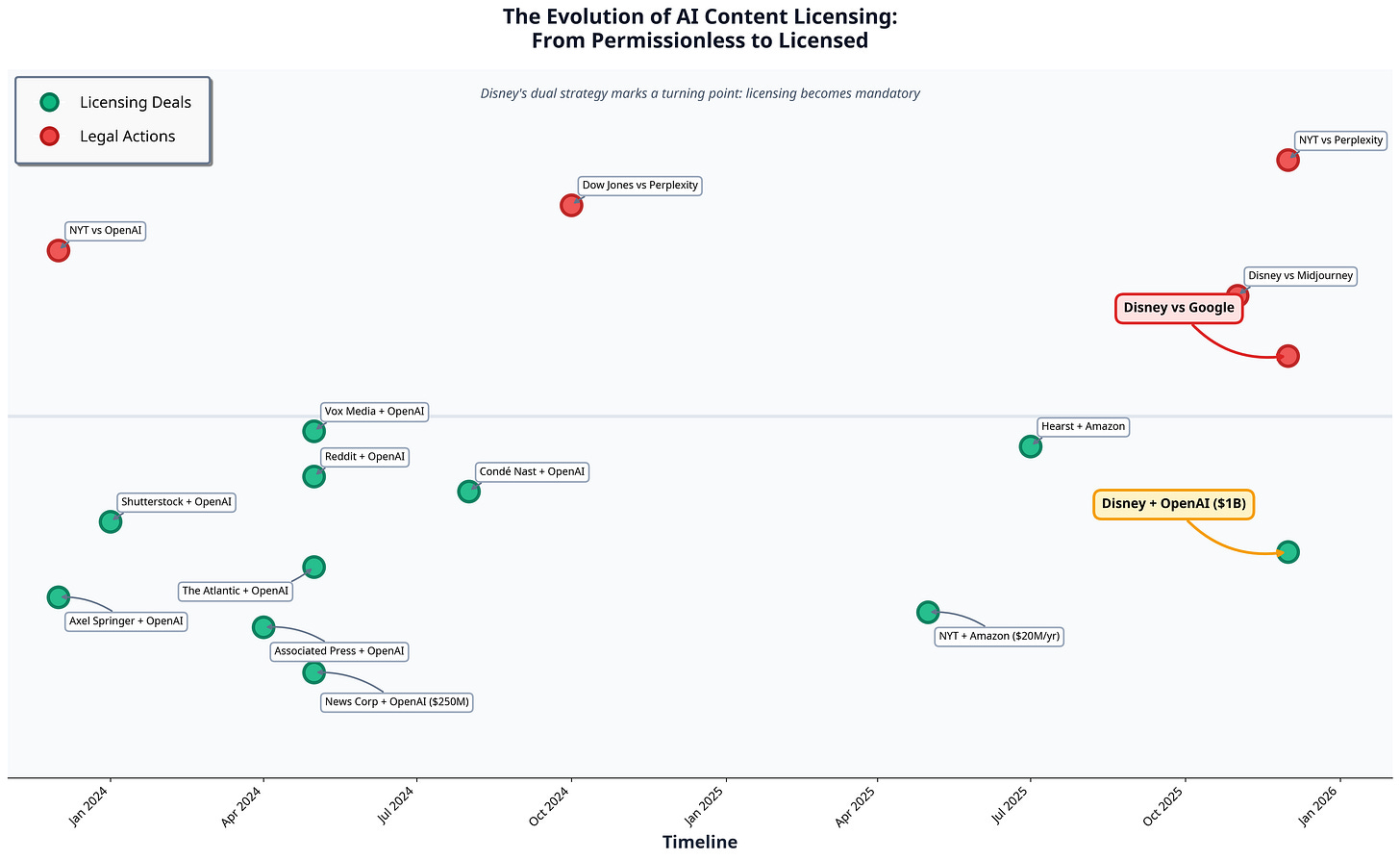
AI-Composed, with Manus.IM, edited by the author.
For years, AI companies have operated under the assumption that they can freely scrape the internet for data to train their models, often invoking the legal doctrine of “fair use.” However, as AI-generated content becomes increasingly sophisticated and commercially viable, this argument is facing growing legal and ethical challenges. Disney’s actions, backed by its immense legal and financial resources, have the potential to set a new legal precedent, one that firmly establishes the principle of “credit, compensation, and consent” for all creators that my AI utility, Credtent, has long endorsed.
As a Disney-trained creative, I know that constraints enable new ideas. Licensing does not stifle innovation. What it does is create a more ethical and inclusive AI ecosystem that enables more people to benefit from the AI economy. It can also drive adoption among skeptical creatives, enabling them to use these tools without feeling that they are betraying their artistic and creative brothers and sisters. A sustainable AI ecosystem cannot be built on a foundation of uncompensated labor. By forcing the issue of licensing, Disney is not just protecting its own intellectual property; it is helping pave the way for a more equitable future for all creators.
The Gap in the Market: Why Corporate Licensing Isn’t Enough
While Disney’s Corporate Licensing Model (CLM) is a powerful tool for large media conglomerates, it does little to address the needs of the vast majority of independent artists, writers, musicians, and filmmakers who lack the leverage to negotiate billion-dollar deals or launch expensive litigation campaigns. This structural gap is precisely why the Creator-Centric Model (CCM), as championed by companies like Credtent.org, becomes essential.
Simply put, most creators do not have Disney’s legal or dealmaking resources. They cannot afford to hire teams of lawyers to send cease and desist letters to tech giants and follow through if they don’t see action. They probably don’t have a salesperson on staff that can negotiate directly with OpenAI or Google for licensing deals. They need a scalable, standardized solution that gives them the same level of control and compensation that Disney has secured for itself, but in a way that is accessible and affordable.
The Corporate Licensing Model works for giants like Disney, but the Creator-Centric Model is essential for everyone else: that means individual artists of all types, but also independent publishers, studios, production companies, record labels, data providers, and creative collectives like unions, guilds, and associations.
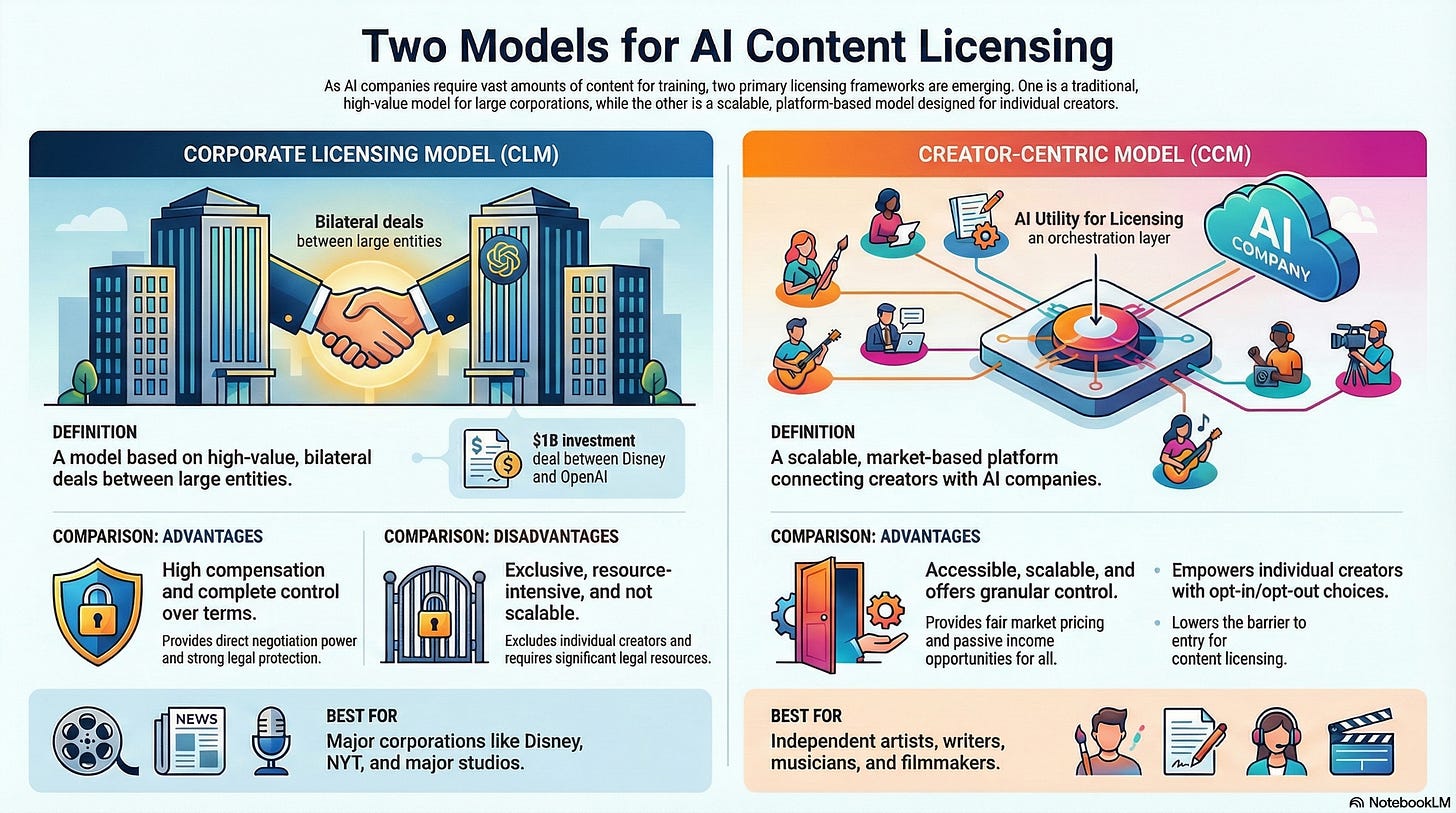
Content created by the author, envisioned with Napkin.ai, modified with Manus.IM, and refined with NotebookLM. Who says AI saves you time?
The Creator-Centric Model: Credtent’s Vision for Mutual Prosperity
As a Public Benefit Corporation, Credtent’s Independent Creative Registry (ICR) platform enables creators to register their work and choose whether to opt-in to licensing agreements or opt-out of having their work used for AI training altogether.
Credtent’s ICR provides a free opt-out option that submits the creative’s work on its industry-wide exclusion list, providing comprehensive communication about your wishes and appropriate guardrail instructions to stop your work’s use in non-licensed AI models. For those who opt-in, the Premium Licensing tier provides the highest level of agency, allowing creators to gain control over their licensing terms, to use Credtent’s special expertise in pricing valuation to understand the monetary value of their work in this market, and even set their own pricing to select which specific AI companies are permitted to train on their content. This scales the bespoke control Disney demanded down to the individual creator level.
We need to know that the original creators of films, books, music, TV shows, art, or other works have not had their rights violated or we will be less interested in using these tools. Credtent is a central AI utility that can provide this much-needed transparency and accountability, ensuring that the AI revolution benefits everyone, not just a handful of tech giants.
Moreover, the ability to restrict use or set custom terms is crucial for protecting the reputation of creative work. A gorgeous film that took years to create is devalued by random AI slop generated in its style without permission or compensation. By providing mechanisms for transparency, consent, and trust, Credtent enables creators to reclaim agency in the AI era.
The Future of AI and Creativity: A Licensed Universe
As AI models become increasingly integrated into our daily lives, the demand for high-quality, ethically sourced training data will only grow. AI companies that pay for this data will have a significant competitive advantage, both in terms of the quality of their models and their ability to attract and retain users who are increasingly concerned about the ethical implications of AI as well as the massive legal ones. The recent $1.5 billion settlement that Anthropic has made with a class of authors whose books they used for training from an illicit dataset opened the eyes of a lot of industry pros. While a $3,000 per book penalty has been assessed, it could have been up to $150,000 per violation, which would have led to a potential judgment of $1 trillion, wiping out the entire market value of Anthropic. No wonder a settlement made sense to them.
In this new paradigm, licensing will become “table stakes” for any AI company that wants to be taken seriously and be able to sell their services to businesses. The days of the Wild West, where AI companies could operate with impunity, are numbered. The future belongs to those who are willing to work with creators, not against them, to build a more equitable and sustainable AI ecosystem.
Market-Based Solutions >>> Regulation or Endless Litigation
Disney’s strategy also demonstrates the power of market-based solutions over regulation or endless litigation. While some have called for strict government regulation of generative AI, AI companies have been effective at stating that regulation stifles innovation and creates barriers to entry that favor established players. While litigation can be an effective tool for protecting rights, it is expensive, time-consuming, and often results in settlements that do little to change industry practices.
By contrast, Disney’s approach of licensing to those AI companies that commit to respecting creators’ rights and taking legal action against those who do not creates a clear incentive structure. AI companies that want access to high-quality, legally clean content already know what they need to do: negotiate fair licensing deals. Those who try to take shortcuts and scrape content without permission will face legal consequences. This market-based approach is more flexible, more scalable, and more effective than regulation or litigation alone.
While some AI companies and government officials have said it is “impossible” to sort out licensing for AI training, Credtent’s ICR already addresses the issue, as Americans have always done when technological or creative innovation has led to new ideas. Capitalism will always find a way and every day, more creative people are getting either profit or protection by signing up with Credtent.
The Price of Provenance
The intellectual property war over generative AI has reached a definitive turning point, cemented by Disney’s approach to the technology. With their moves this week, Disney has established a new market dynamic: IP licensing is no longer optional for AI firms, but a mandatory, high-cost operational expenditure. Virtually at the same time, we saw the Trump Administration issue an executive order to curb state-level legislation about AI, and there was no reference to AI and IP issues. That’s because the US is the content capitol of the world, with about two trillion dollars added to the country’s GDP from creative companies each year. We need to win at AI, but we also need to preserve the entertainment business that is so vital to our national identity and a huge component of the business we conduct in this country.
The market trajectory is clear: licensing is rapidly transitioning from being an optional courtesy to becoming a fundamental, non-negotiable operational expenditure for all generative AI model developers. This shift, driven by corporate litigation and institutionalized by platforms like Credtent, is essential for ensuring that innovation and creative rights thrive together.
The road ahead may be fraught with legal and ethical challenges, but one thing is certain: the collision of AI and creativity has sparked a revolution, and the aftershocks will be felt for years to come. Disney has highlighted the path we’ve been beating the drum about, where technology innovators and creative industries can work together and thrive, where the world of AI does not have to be lawless, and where the value of creators and their works is respected and protected.
The future is licensed, ethical, and commercially safe. And the future is one where all creators, not just the giants, have the power to control their work and benefit from the AI economy.
Full disclosure: The author is the CEO and Co-Founder of Credtent.org.
AI-Assisted: This article incorporates insights from the authors original commentary on Disney’s AI strategy, along with comprehensive research on the Disney-OpenAI partnership and Disney’s legal actions against Google using AI tools and plus a lot of reading.
About the Author

E.R. Burgess
Contributor on AI, ethics, and creator rights.